
Stray Light Analysis#
Stray light is any light that reaches the detector via an unintended path. In imaging systems the most common form is ghost images — weak secondary images caused by multiple internal reflections from lens surfaces.
The NSQ engine is ideal for stray light analysis because rays propagate freely between any surfaces and every Fresnel reflection is tracked probabilistically.
This notebook demonstrates:
Converting a sequential design to an NSQ scene with
sequential_to_nonsequentialUsing
max_depthto reveal ghost contributionsComparing single-pass vs. multi-bounce irradiance
Suppressing ghosts with AR coatings, and using importance-biased sampling to measure the resulting faint ghost without a huge ray budget
[1]:
import matplotlib.pyplot as plt
import numpy as np
import warnings

from optiland.coatings import SimpleCoating
from optiland.coordinate_system import CoordinateSystem
from optiland.nonsequential import (
    NSQScene, Spectrum,
    CollimatedSourceConfig,
    IrradianceDetectorConfig,
    LensConfig, SurfaceConfig,
    sequential_to_nonsequential,
)
from optiland.nonsequential.ir.scene_ir import SamplingPolicy
1. Why Sequential-to-NSQ Conversion?#
The sequential tracer assumes all light is transmitted at every surface — there are no reflected beams. The NSQ tracer applies Fresnel splitting at every uncoated interface: each ray is probabilistically refracted or reflected based on the Fresnel equations.
sequential_to_nonsequential converts an Optic sequential design into an NSQScene automatically:
Singlet surfaces →
LenscomponentsCemented doublets →
DoubletcomponentsMirror surfaces →
MirrorcomponentsImage surface →
IrradianceDetectorEach sequential field → one NSQ source
[2]:
from optiland.samples.objectives import CookeTriplet

triplet = CookeTriplet()

# Suppress the expected Fresnel-reflection warning from the converter
with warnings.catch_warnings():
    warnings.simplefilter('ignore')
    scene_triplet = sequential_to_nonsequential(
        triplet,
        detector_pixels=(256, 256),
    )

print("Compound components:", scene_triplet.component_names)
print("Sources            :", scene_triplet.source_names)
print("Detectors          :", scene_triplet.detector_names)
print(f"Total surfaces     : {len(scene_triplet.surfaces)}")
Compound components: ['L1', 'L3', 'L5']
Sources            : ['S0', 'S1', 'S2']
Detectors          : ['D1']
Total surfaces     : 12
2. Baseline Trace#
max_depth counts every interaction a ray has, including the one with the detector. So the smallest value that lets light through a system is
max_depth >= (number of refracting surfaces on the direct path) + 1
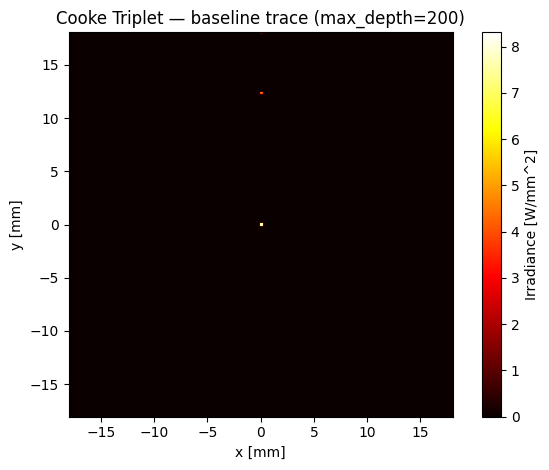
A Cooke Triplet has 6 refracting surfaces, so max_depth=7 is the minimum for a direct image and anything above that starts adding ghost paths. We use a generous limit here so the baseline includes the full Fresnel behaviour.
Note the converter creates one source per sequential field, so total_flux_in is the sum over all fields rather than 1 W.
[3]:
result_base = scene_triplet.trace(num_rays=100_000, max_depth=200, seed=42)
irr_base = result_base.detectors['D1']

print(f"Baseline flux on detector: {irr_base.total_flux:.5f} W")
print(f"Rays on detector         : {irr_base.num_rays_hit:,}")

fig = irr_base.plot(cmap='hot')
plt.title('Cooke Triplet — baseline trace (max_depth=200)')
plt.tight_layout()
plt.show()
plt.close(fig)
Baseline flux on detector: 1.70100 W
Rays on detector         : 56,750
3. Limited-Bounce Comparison#
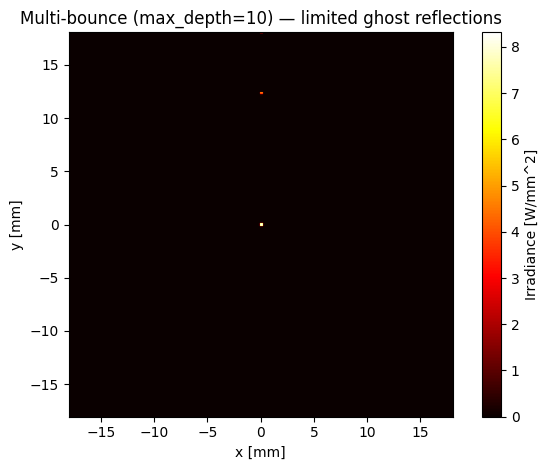
Lowering max_depth restricts how many surface interactions each ray can have. Rays exceeding the limit are killed without reaching the detector. Here we compare a tight limit (few ghost paths possible) against the full trace:
[4]:
# Rebuild scene each trace (detectors accumulate across calls)
with warnings.catch_warnings():
    warnings.simplefilter('ignore')
    scene_ghosts = sequential_to_nonsequential(
        CookeTriplet(),
        detector_pixels=(256, 256),
    )

result_ghosts = scene_ghosts.trace(
    num_rays=200_000,
    max_depth=10,
    min_flux_fraction=1e-8,  # track very faint rays
    seed=42,
)
irr_ghosts = result_ghosts.detectors['D1']

print(f"Multi-bounce flux on detector : {irr_ghosts.total_flux:.5f} W")
print(f"Rays on detector              : {irr_ghosts.num_rays_hit:,}")

fig = irr_ghosts.plot(cmap='hot')
plt.title('Multi-bounce (max_depth=10) — limited ghost reflections')
plt.tight_layout()
plt.show()
plt.close(fig)
Multi-bounce flux on detector : 1.69661 W
Rays on detector              : 113,206
4. Ghost Contribution as a Function of Bounces#
Track how the detected flux changes as we allow more reflections:
[5]:
bounce_levels = [10, 20, 50, 100, 200]
detected_fluxes = []

for max_b in bounce_levels:
    with warnings.catch_warnings():
        warnings.simplefilter('ignore')
        sc = sequential_to_nonsequential(CookeTriplet(), detector_pixels=(128, 128))
    r = sc.trace(num_rays=50_000, max_depth=max_b, min_flux_fraction=1e-8, seed=42)
    detected_fluxes.append(r.detectors['D1'].total_flux)

# Compute ghost fraction relative to lowest-bounce baseline (guard against zero)
base = detected_fluxes[0] if detected_fluxes[0] > 1e-12 else max(detected_fluxes)
ghost_fractions = [
    (f - base) / base * 100
    for f in detected_fluxes
]

fig, axes = plt.subplots(1, 2, figsize=(11, 4))
axes[0].plot(bounce_levels, detected_fluxes, 'o-')
axes[0].set_xlabel('max_depth')
axes[0].set_ylabel('Flux on detector [W]')
axes[0].set_title('Detected flux vs. bounce limit')
axes[0].grid(True, alpha=0.4)

axes[1].plot(bounce_levels, ghost_fractions, 's-', color='orange')
axes[1].set_xlabel('max_depth')
axes[1].set_ylabel('Flux change vs. baseline [%]')
axes[1].set_title('Ghost/stray contribution vs. bounce limit')
axes[1].grid(True, alpha=0.4)

plt.tight_layout()
plt.show()
plt.close(fig)

for b, f, g in zip(bounce_levels, detected_fluxes, ghost_fractions):
    print(f"max_depth={b:>3}: flux={f:.5f} W  delta={g:+.3f}%")
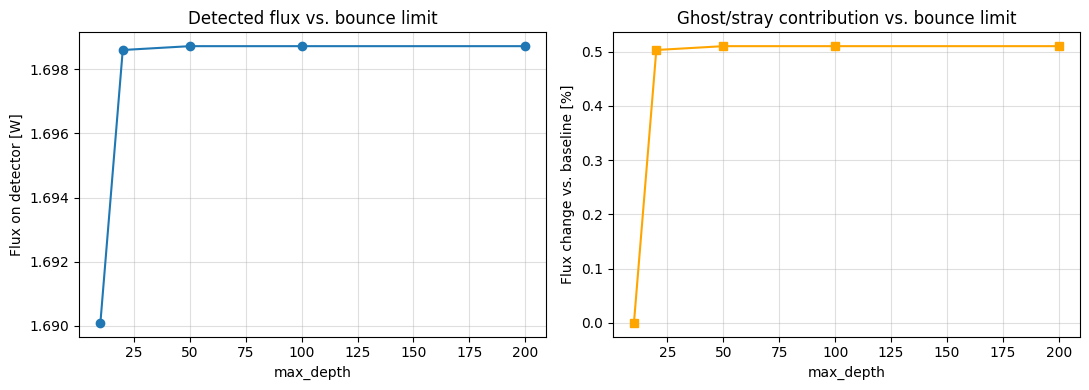
max_depth= 10: flux=1.69010 W  delta=+0.000%
max_depth= 20: flux=1.69860 W  delta=+0.503%
max_depth= 50: flux=1.69872 W  delta=+0.510%
max_depth=100: flux=1.69872 W  delta=+0.510%
max_depth=200: flux=1.69872 W  delta=+0.510%
5. Isolating the Ghost Contribution#
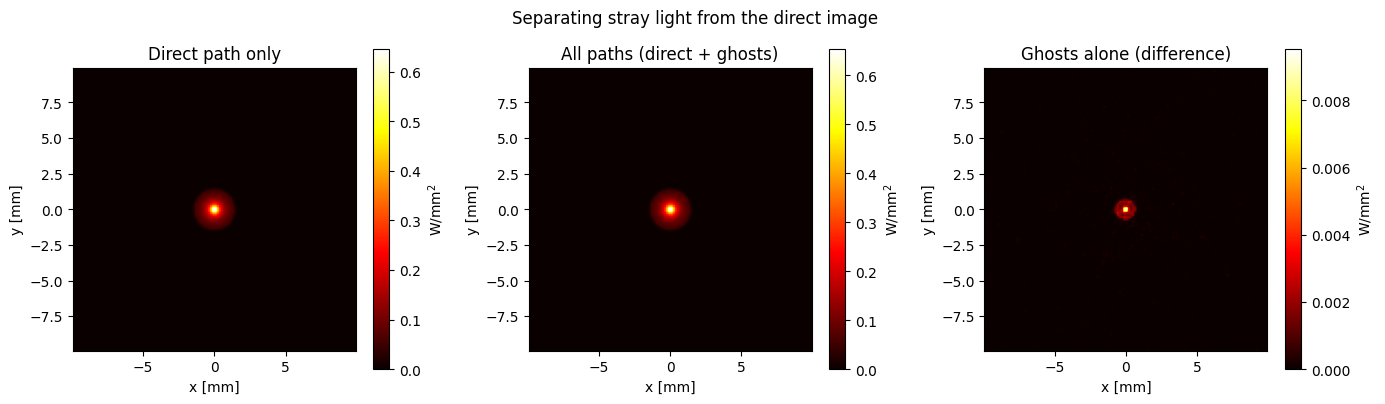
Building a scene by hand gives full control over the bounce budget, and comparing two bounce limits separates the direct image from the stray light:
max_depth = surfaces + 1allows only the direct path.A larger limit additionally admits rays that reflected an even number of times inside the system, which is exactly what forms a ghost.
Subtracting the two irradiance maps leaves the ghost pattern on its own.
Every surface below is left uncoated on purpose, so this is bare-Fresnel physics: ~4% reflectance at each glass-air interface. That is close to a worst case — most real imaging lenses carry an AR coating specifically to suppress this — and section 6 quantifies just how much difference that coating makes on this exact system.
[6]:
spec = Spectrum.monochromatic(0.55)


def build_stray_scene():
    """Two-element system: 4 refracting surfaces on the direct path."""
    sc = NSQScene()
    sc.add_source(
        'S', CoordinateSystem(z=-80),
        CollimatedSourceConfig(spectrum=spec, total_flux=1.0, aperture_radius=10.0),
    )
    sc.add_lens(
        'L1', CoordinateSystem(z=0),
        LensConfig(r1=50, r2=-50, thickness=5, material='N-BK7',
                   front_aperture_radius=12.5),
    )
    sc.add_lens(
        'L2', CoordinateSystem(z=40),
        LensConfig(r1=-80, r2=80, thickness=4, material='N-SF5',
                   front_aperture_radius=12.5),
    )
    # The biconvex/biconcave pair focuses at z = 60 mm. Stray light is judged
    # against the signal, so the detector belongs where the signal is: at the
    # image, where the wanted light is concentrated and any ghost is not.
    sc.add_detector(
        'D', CoordinateSystem(z=60),
        IrradianceDetectorConfig(width=20, height=20,
                                 num_pixels_x=128, num_pixels_y=128),
    )
    return sc


# 4 refracting surfaces + 1 detector hit = 5 interactions for the direct path.
r_direct = build_stray_scene().trace(
    num_rays=200_000, max_depth=5, min_flux_fraction=1e-8, seed=42)
r_full = build_stray_scene().trace(
    num_rays=200_000, max_depth=16, min_flux_fraction=1e-8, seed=42)

i_direct = r_direct.detectors['D']
i_full = r_full.detectors['D']
ghost_flux = i_full.total_flux - i_direct.total_flux

print(f"Direct path only (max_depth=5) : {i_direct.total_flux:.5f} W "
      f"({i_direct.num_rays_hit:,} rays)")
print(f"All paths (max_depth=16)       : {i_full.total_flux:.5f} W "
      f"({i_full.num_rays_hit:,} rays)")
print(f"Ghost contribution             : {ghost_flux:.5f} W "
      f"({ghost_flux / i_full.total_flux * 100:.2f}% of the detected light)")

ghost_map = i_full.irradiance - i_direct.irradiance
extent = [i_full.x_coords[0], i_full.x_coords[-1],
          i_full.y_coords[0], i_full.y_coords[-1]]

fig, axes = plt.subplots(1, 3, figsize=(14, 4))
for ax, data, title in zip(
    axes,
    [i_direct.irradiance, i_full.irradiance, ghost_map],
    ['Direct path only', 'All paths (direct + ghosts)', 'Ghosts alone (difference)'],
):
    im = ax.imshow(data, origin='lower', extent=extent, cmap='hot')
    plt.colorbar(im, ax=ax, label='W/mm$^2$')
    ax.set_title(title)
    ax.set_xlabel('x [mm]')
    ax.set_ylabel('y [mm]')

plt.suptitle('Separating stray light from the direct image', fontsize=12)
plt.tight_layout()
plt.show()
Direct path only (max_depth=5) : 0.80252 W (160,914 rays)
All paths (max_depth=16)       : 0.80974 W (162,368 rays)
Ghost contribution             : 0.00722 W (0.89% of the detected light)
6. AR Coatings Suppress Ghosts#
SurfaceConfig(coating=...), passed as front=/back= on a LensConfig, attaches a real coating model from optiland.coatings to a refractive face — the same model class the sequential engine uses, so NSQ and the sequential tracer agree on R/T for that coating. A bare glass-air interface reflects about 4% (the Fresnel value used implicitly in section 5); a single-layer AR coating (e.g. MgF2, quarter-wave at the design wavelength) brings that down to roughly 0.25% — about a 16x
drop in the reflectance feeding every ghost path, and since a ghost involves two such reflections, the drop in ghost flux compounds well beyond that.
There is a sampling wrinkle that comes with the coating being this effective. At 0.25% reflectance, the reflect branch is a genuinely rare event, so scene.sampling_policy = SamplingPolicy(reflect_prob=0.25) fixes the reflect/refract branch probability at 25% regardless of the physical reflectance — the throughput weight compensates so the expected result is unchanged (the same detached-sample / attached-weight estimator described in the developer guide), and only the variance improves. The
same policy must be applied to both the direct-only and full-depth traces being compared — used consistently, the two traces share the same biased branch decisions at the surfaces the direct path also crosses, so that shared randomness cancels in the subtraction instead of adding two independently noisy estimates together.
[7]:
# A representative single-layer AR coat: ~0.25% reflectance, no absorption.
AR_COATING = SimpleCoating(reflectance=0.0025, transmittance=0.9975)


def build_stray_scene(coated=False):
    """Same two-element system as section 5, optionally with an AR coating
    on every refractive face."""
    sc = NSQScene()
    sc.add_source(
        'S', CoordinateSystem(z=-80),
        CollimatedSourceConfig(spectrum=spec, total_flux=1.0, aperture_radius=10.0),
    )
    face = SurfaceConfig(coating=AR_COATING) if coated else None
    sc.add_lens(
        'L1', CoordinateSystem(z=0),
        LensConfig(r1=50, r2=-50, thickness=5, material='N-BK7',
                   front_aperture_radius=12.5, front=face, back=face),
    )
    sc.add_lens(
        'L2', CoordinateSystem(z=40),
        LensConfig(r1=-80, r2=80, thickness=4, material='N-SF5',
                   front_aperture_radius=12.5, front=face, back=face),
    )
    sc.add_detector(
        'D', CoordinateSystem(z=60),
        IrradianceDetectorConfig(width=20, height=20,
                                 num_pixels_x=128, num_pixels_y=128),
    )
    return sc


def ghost_flux(coated, reflect_prob='fresnel', num_rays=200_000, seed=42):
    """Direct-only vs. full-depth flux under one sampling policy, applied to
    *both* traces so their shared randomness at the surfaces they have in
    common cancels in the subtraction rather than adding independent noise."""
    sc_direct = build_stray_scene(coated)
    sc_full = build_stray_scene(coated)
    policy = SamplingPolicy(reflect_prob=reflect_prob)
    sc_direct.sampling_policy = policy
    sc_full.sampling_policy = policy

    r_d = sc_direct.trace(num_rays=num_rays, max_depth=5,
                          min_flux_fraction=1e-9, seed=seed)
    r_f = sc_full.trace(num_rays=num_rays, max_depth=16,
                        min_flux_fraction=1e-9, seed=seed)
    direct = r_d.detectors['D'].total_flux
    full = r_f.detectors['D'].total_flux
    return direct, full, full - direct


# Same 200k-ray budget as section 5.
d_bare, f_bare, ghost_bare = ghost_flux(coated=False)
d_ar, f_ar, ghost_ar = ghost_flux(coated=True, reflect_prob=0.25)

print("Uncoated (bare Fresnel):")
print(f"  direct={d_bare:.5f} W  full={f_bare:.5f} W  "
      f"ghost={ghost_bare:.6f} W ({ghost_bare / f_bare * 100:.3f}% of detected)")
print("\nAR-coated (importance-biased sampling, reflect_prob=0.25):")
print(f"  direct={d_ar:.5f} W  full={f_ar:.5f} W  "
      f"ghost={ghost_ar:.7f} W ({ghost_ar / f_ar * 100:.5f}% of detected)")
print(f"\nGhost flux, uncoated -> AR-coated: {ghost_bare / ghost_ar:.0f}x reduction")
print(f"Direct-path flux is also higher with coating: {d_ar:.5f} W vs "
      f"{d_bare:.5f} W uncoated (less flux lost to reflection, more transmitted)")
Uncoated (bare Fresnel):
  direct=0.80252 W  full=0.80974 W  ghost=0.007224 W (0.892% of detected)

AR-coated (importance-biased sampling, reflect_prob=0.25):
  direct=0.98220 W  full=0.98222 W  ghost=0.0000194 W (0.00198% of detected)

Ghost flux, uncoated -> AR-coated: 372x reduction
Direct-path flux is also higher with coating: 0.98220 W vs 0.80252 W uncoated (less flux lost to reflection, more transmitted)
How much does importance biasing actually help?#
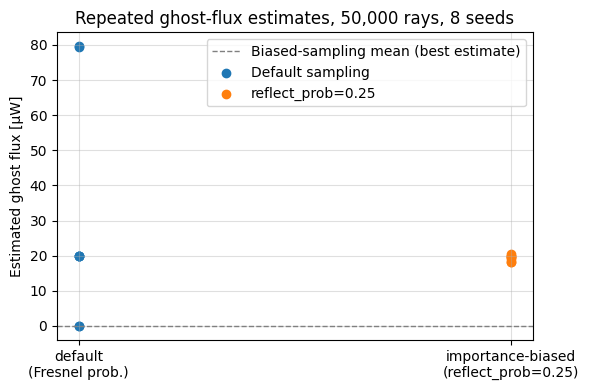
To see the variance reduction directly, repeat the AR-coated ghost measurement at a much smaller ray budget (50,000 rays — a quarter of what was used above), several times with different seeds, once under the default Fresnel-probability sampling and once under reflect_prob=0.25. If biasing is doing its job, the biased estimates should cluster tightly around the true value while the default ones scatter widely — same expectation, very different spread.
[8]:
n_repeats = 8
budget = 50_000


def repeated_ghosts(reflect_prob):
    return np.array([
        ghost_flux(coated=True, reflect_prob=reflect_prob,
                  num_rays=budget, seed=s)[2]
        for s in range(n_repeats)
    ])


ghosts_default = repeated_ghosts('fresnel')
ghosts_biased = repeated_ghosts(0.25)

rel_std_default = 100 * ghosts_default.std() / ghosts_default.mean()
rel_std_biased = 100 * ghosts_biased.std() / ghosts_biased.mean()
variance_reduction = (ghosts_default.std() / ghosts_biased.std()) ** 2

print(f"{budget:,} rays x {n_repeats} repeats, AR-coated ghost flux estimate:")
print(f"  default sampling   : mean={ghosts_default.mean():.6f} W, "
      f"rel. std={rel_std_default:.0f}%")
print(f"  reflect_prob=0.25  : mean={ghosts_biased.mean():.6f} W, "
      f"rel. std={rel_std_biased:.1f}%")
print(f"  variance reduction : {variance_reduction:.0f}x, at zero extra ray cost")

fig, ax = plt.subplots(figsize=(6, 4))
ax.axhline(ghosts_biased.mean(), color='gray', lw=1, ls='--',
           label='Biased-sampling mean (best estimate)')
ax.scatter(np.zeros(n_repeats), ghosts_default * 1e6, label='Default sampling')
ax.scatter(np.ones(n_repeats), ghosts_biased * 1e6, label='reflect_prob=0.25')
ax.set_xticks([0, 1])
ax.set_xticklabels(['default\n(Fresnel prob.)', 'importance-biased\n(reflect_prob=0.25)'])
ax.set_ylabel('Estimated ghost flux [µW]')
ax.set_title(f'Repeated ghost-flux estimates, {budget:,} rays, {n_repeats} seeds')
ax.legend()
ax.grid(True, alpha=0.4)
plt.tight_layout()
plt.show()
plt.close(fig)
50,000 rays x 8 repeats, AR-coated ghost flux estimate:
  default sampling   : mean=0.000030 W, rel. std=100%
  reflect_prob=0.25  : mean=0.000019 W, rel. std=3.8%
  variance reduction : 1620x, at zero extra ray cost
Summary#
sequential_to_nonsequential(optic)converts anOpticinto anNSQSceneThe NSQ tracer applies Fresnel splitting at every uncoated interface, which is what produces ghosts; the sequential tracer transmits everything
max_depthcounts every interaction including the detector hit, so the direct path needssurfaces + 1. Anything beyond that admits ghost pathsTracing the same scene at two bounce limits and subtracting the irradiance maps isolates the stray-light pattern
min_flux_fractionsets the Russian-roulette threshold that decides how far faint ghost rays are followed before being unbiasedly killed; lower it when chasing weak stray lightSurfaceConfig(coating=SimpleCoating(...)), attached viafront=/back=on aLensConfig, models a real AR coating instead of bare Fresnel — going from ~4% uncoated reflectance to a ~0.25% single-layer AR coat suppresses ghost flux by roughly an order of magnitude on the two-lens example above. Ghost/stray-light numbers computed without coatings overstate what a real, coated lens would actually produce — treat an uncoated analysis as a worst-case bound, not a predictionscene.sampling_policy = SamplingPolicy(reflect_prob=...)biases how often the tracer samples the reflect branch (with a compensating weight, so the expected result is unchanged) — essential for getting usable statistics on a faint, AR-coated ghost without a much larger ray budgetMirrors also carry a required, physically real
reflectancenow (see notebook 09), so a stray-light budget that includes mirrors is likewise more meaningful than a model that silently assumed 100% reflectionresult.report()flags undersampled detectors and Russian-roulette losses — worth checking whenever a faint stray-light signal is the thing you actually care about