
Longitudinal Aberration#
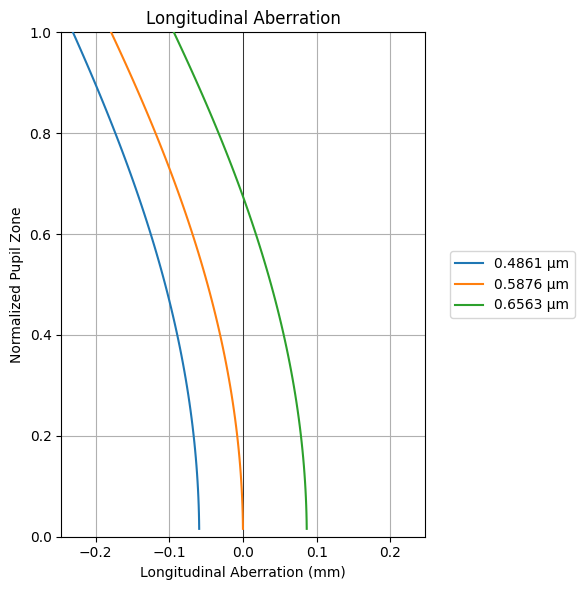
Longitudinal aberration shows where each zone of the pupil brings an on-axis ray to focus, measured along the axis from the image surface. Plotting it for several wavelengths shows spherical aberration and spherochromatism (the change of spherical aberration with wavelength) at a glance.
[1]:
from optiland.analysis import LongitudinalAberration
from optiland.samples.objectives import DoubleGauss
[2]:
lens = DoubleGauss()
[3]:
fig, ax = lens.draw()
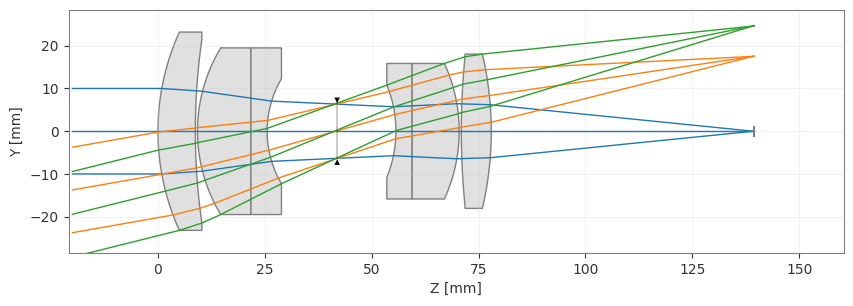
For each wavelength, one on-axis ray is traced through each pupil zone Py from near 0 to 1. In the image surface’s local frame, its axis crossing measured from the image surface vertex is Δz = z − y · N / M, where (y, z) is where the ray lands on the image surface and M, N are its direction cosines. On a flat image surface z = 0.
[4]:
la = LongitudinalAberration(lens)
fig, ax = la.view()
How to read the plot:
The y-axis is the normalized pupil zone, from the axis (0) to the edge of the pupil (1). The x-axis is the focus position of that zone, in mm from the image surface. For this lens the light travels toward +z, so a positive value means the zone focuses past the image surface.
A vertical line means no spherical aberration: every zone focuses at the same place. Curvature of a line is spherical aberration.
The horizontal gap between wavelengths at the smallest zone (the bottom of each curve) is axial color. A change in the shape of the curves between wavelengths is spherochromatism.
Near the axis, the curves meet the paraxial focus. The paraxial focus offset from the image surface is −y/u of a paraxial marginal ray:
[5]:
import optiland.backend as be

la_fine = LongitudinalAberration(lens, num_points=256)
for wp, dz in zip(la_fine.wavelengths, la_fine.data["delta_z"]):
    lens.paraxial.trace(0, 1, wp.value)
    paraxial = -lens.surfaces.y[-1] / lens.surfaces.u[-1]
    print(
        f"{wp.value:.4f} µm: smallest zone {float(dz[0]):+.5f} mm, "
        f"paraxial focus {float(be.to_numpy(paraxial).ravel()[0]):+.5f} mm"
    )
0.4861 µm: smallest zone -0.05938 mm, paraxial focus -0.05938 mm
0.5876 µm: smallest zone +0.00001 mm, paraxial focus +0.00001 mm
0.6563 µm: smallest zone +0.08655 mm, paraxial focus +0.08655 mm