Thin Films
Thin-Film Optimization
Automate layer thickness design to meet spectral performance targets.
AdvancedCoatings & PolarizationNumPy backend15 min read
Introduction
We optimize a thin-film stack to create a dichroic mirror that separates s and p polarizations near 600 nm.
This version demonstrates the operand-centric architecture in ThinFilmOptimizer with a single API entry point:
- standard spectral operands with add_operand(...)
- a custom user-defined operand registered with register_operand(...) and used through add_operand(...)
Core concepts used
ThinFilmOptimizer(stack)
The optimization engine for thin-film designs. It connects a stack to local and global solvers.
optimizer.add_variable(index, min_nm, max_nm)
Defines a layer's physical thickness as a design parameter, subject to manufacturing constraints.
register_operand(name, func)
Registers a custom user-defined merit function to prioritize non-standard targets (like polarization contrast).
optimizer.optimize(method='L-BFGS-B')
Launches the solver. L-BFGS-B is ideal for constrained optimization where layer thickness must remain positive.
Step-by-step build
1
Import libraries and build the dichroic stack
python
from optiland.thin_film.optimization import ThinFilmOptimizer
import optiland.backend as be
from optiland.thin_film import ThinFilmStack, SpectralAnalyzer
from optiland.materials import Material, IdealMaterial

SiO2 = Material("SiO2", reference="Gao")
TiO2 = Material("TiO2", reference="Zhukovsky")
BK7 = Material("N-BK7", reference="SCHOTT")
air = IdealMaterial(n=1.0)

dichroic_stack = ThinFilmStack(
 incident_material=air,
 substrate_material=BK7,
 reference_wl_um=0.6,
 reference_AOI_deg=45.0,
)
for i in range(10):  # 10 pairs = 20 layers
 dichroic_stack.add_layer_qwot(material=TiO2, qwot_thickness=1.0, name=f"$TiO_2$")
 dichroic_stack.add_layer_qwot(material=SiO2, qwot_thickness=1.0, name=f"$SiO_2$")
2
Register a custom polarization-contrast operand and configure variables
python
optimizer = ThinFilmOptimizer(dichroic_stack)

# Add all thicknesses as optimization variables
for i in range(len(dichroic_stack.layers)):
 optimizer.add_variable(
     layer_index=i,
     min_nm=30,
     max_nm=300
 )

# we want to maximize the polarization contrast (Rs-Rp) at 600 nm and 45° AOI, so we
# minimize the negative contrast, averaged over a wavelength range to make it more
# robust to fabrication variations. The contrast is normalized to be between 0 and 1,
# where 1 corresponds to Rs=1 and Rp=0
wl_nm = be.linspace(595, 605, 11)

# Register and add a custom operand through add_operand
def polarization_contrast(
 stack: ThinFilmStack, wavelength_nm: be.ndarray, aoi_deg: float
):
 """Calculate the polarization contrast (Rs-Rp) averaged over a wavelength range.
 The contrast is normalized to be between 0 and 1,
 where 1 corresponds to Rs=1 and Rp=0."""
 rs = stack.reflectance_nm_deg(wavelength_nm, aoi_deg, "s")
 rp = stack.reflectance_nm_deg(wavelength_nm, aoi_deg, "p")
 return (1 + be.mean(rs - rp))/2

ThinFilmOptimizer.register_operand(
 "polarization_contrast", polarization_contrast, overwrite=True
)

optimizer.add_operand(
 property="polarization_contrast",
 min_val=0.99,
 input_data={"wavelength_nm": wl_nm, "aoi_deg": 45.0},
 label="Rs-Rp @ 595-605nm, 45deg",
)

# Display optimization information
optimizer.info()
contrast_initial=optimizer.rss()
print(f"Initial RSS: {contrast_initial:.6e}")
3
Run the L-BFGS-B optimizer
python
# Launch optimization
result = optimizer.optimize(
 method="L-BFGS-B",
 max_iterations=1000,
)

print(
 f"Merit: {result['initial_merit']:.15f} -> "
 f"{result['final_merit']:.15f} in {result['iterations']} iterations"
)
print(f"Improvement: {result['improvement']:.15f}")
4
Generate the optimization summary report
python
from optiland.thin_film.optimization import ThinFilmReport

report = ThinFilmReport(optimizer, result)
report.summary_table()
5
Plot spectral performance, polarization contrast, and optimized stack structure
python
import matplotlib.pyplot as plt

analyzer = SpectralAnalyzer(dichroic_stack)
fig, axes = plt.subplots(1, 3, figsize=(12, 4))

wl_range = be.linspace(500, 700, 201)  # Around 600 nm

# Calculate before optimization (reset and recalculate)
optimizer.reset()
Rs_before = dichroic_stack.reflectance_nm_deg(wl_range, 45, 's')
Rp_before = dichroic_stack.reflectance_nm_deg(wl_range, 45, 'p')

# Restore optimized state
for i, var_info in enumerate(optimizer.variables):
 final_thickness = result['thickness_changes'][i]['final_nm'] / 1000  # nm → μm
 dichroic_stack.layers[i].update_thickness(final_thickness)

Rs_after = dichroic_stack.reflectance_nm_deg(wl_range, 45, 's')
Rp_after = dichroic_stack.reflectance_nm_deg(wl_range, 45, 'p')

axes[0].plot(wl_range, Rs_before, 'b:', label='$R_s$ before', alpha=0.7)
axes[0].plot(wl_range, Rp_before, 'g:', label='$P_p$ before', alpha=0.7)
axes[0].plot(wl_range, Rs_after, 'b-', label='$R_s$ after', linewidth=2)
axes[0].plot(wl_range, Rp_after, 'g-', label='$P_p$ after', linewidth=2)
axes[0].set_xlabel('$\lambda$ (nm)')
axes[0].set_ylabel('Reflectance')
axes[0].set_title('Spectral Performance (AOI=45°)')
axes[0].legend()
axes[0].grid(True, alpha=0.3)
axes[0].fill_betweenx([0, 1], 595, 605,
                   color='gray', alpha=0.2, label='Optimization Range')

# 2. Polarization contrast (Rs - Rp)
contrast_before = Rs_before - Rp_before
contrast_after = Rs_after - Rp_after

axes[1].plot(wl_range, contrast_before, 'g--', label='Before', alpha=0.7)
axes[1].plot(wl_range, contrast_after, 'g-', label='After', linewidth=2)
axes[1].set_xlabel('$\lambda$ (nm)')
axes[1].set_ylabel('Contrast ($R_s - R_p$)')
axes[1].set_title('Polarization Contrast')
axes[1].legend()
axes[1].grid(True, alpha=0.3)

# 3. Optimized stack structure
dichroic_stack.plot_structure_thickness(axes[2])
axes[2].set_title('Optimized Stack Structure')
fig.tight_layout()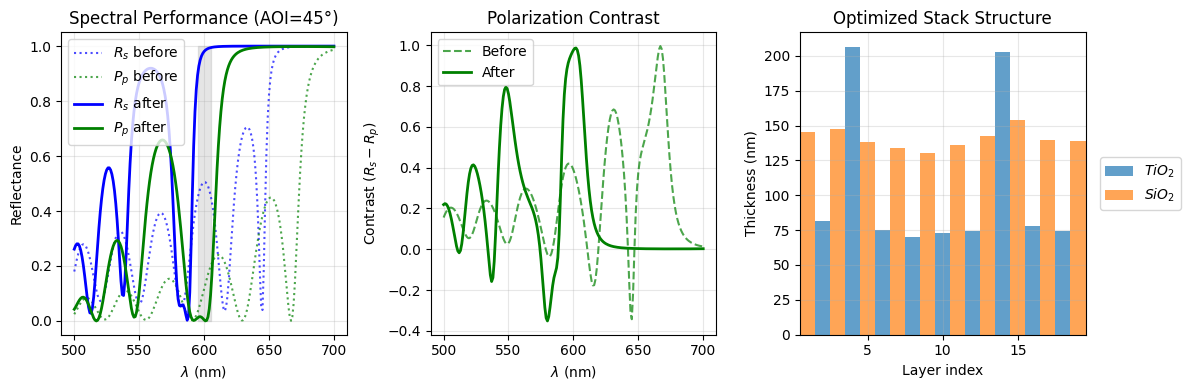
Show full code listing
python
from optiland.thin_film.optimization import ThinFilmOptimizer
import optiland.backend as be
from optiland.thin_film import ThinFilmStack, SpectralAnalyzer
from optiland.materials import Material, IdealMaterial

SiO2 = Material("SiO2", reference="Gao")
TiO2 = Material("TiO2", reference="Zhukovsky")
BK7 = Material("N-BK7", reference="SCHOTT")
air = IdealMaterial(n=1.0)

dichroic_stack = ThinFilmStack(
  incident_material=air,
  substrate_material=BK7,
  reference_wl_um=0.6,
  reference_AOI_deg=45.0,
)
for i in range(10):  # 10 pairs = 20 layers
  dichroic_stack.add_layer_qwot(material=TiO2, qwot_thickness=1.0, name=f"$TiO_2$")
  dichroic_stack.add_layer_qwot(material=SiO2, qwot_thickness=1.0, name=f"$SiO_2$")

optimizer = ThinFilmOptimizer(dichroic_stack)

# Add all thicknesses as optimization variables
for i in range(len(dichroic_stack.layers)):
  optimizer.add_variable(
      layer_index=i,
      min_nm=30,
      max_nm=300
  )

# we want to maximize the polarization contrast (Rs-Rp) at 600 nm and 45° AOI, so we
# minimize the negative contrast, averaged over a wavelength range to make it more
# robust to fabrication variations. The contrast is normalized to be between 0 and 1,
# where 1 corresponds to Rs=1 and Rp=0
wl_nm = be.linspace(595, 605, 11)

# Register and add a custom operand through add_operand
def polarization_contrast(
  stack: ThinFilmStack, wavelength_nm: be.ndarray, aoi_deg: float
):
  """Calculate the polarization contrast (Rs-Rp) averaged over a wavelength range.
  The contrast is normalized to be between 0 and 1,
  where 1 corresponds to Rs=1 and Rp=0."""
  rs = stack.reflectance_nm_deg(wavelength_nm, aoi_deg, "s")
  rp = stack.reflectance_nm_deg(wavelength_nm, aoi_deg, "p")
  return (1 + be.mean(rs - rp))/2

ThinFilmOptimizer.register_operand(
  "polarization_contrast", polarization_contrast, overwrite=True
)

optimizer.add_operand(
  property="polarization_contrast",
  min_val=0.99,
  input_data={"wavelength_nm": wl_nm, "aoi_deg": 45.0},
  label="Rs-Rp @ 595-605nm, 45deg",
)

# Display optimization information
optimizer.info()
contrast_initial=optimizer.rss()
print(f"Initial RSS: {contrast_initial:.6e}")

# Launch optimization
result = optimizer.optimize(
  method="L-BFGS-B",
  max_iterations=1000,
)

print(
  f"Merit: {result['initial_merit']:.15f} -> "
  f"{result['final_merit']:.15f} in {result['iterations']} iterations"
)
print(f"Improvement: {result['improvement']:.15f}")

from optiland.thin_film.optimization import ThinFilmReport

report = ThinFilmReport(optimizer, result)
report.summary_table()


import matplotlib.pyplot as plt

analyzer = SpectralAnalyzer(dichroic_stack)
fig, axes = plt.subplots(1, 3, figsize=(12, 4))

wl_range = be.linspace(500, 700, 201)  # Around 600 nm

# Calculate before optimization (reset and recalculate)
optimizer.reset()
Rs_before = dichroic_stack.reflectance_nm_deg(wl_range, 45, 's')
Rp_before = dichroic_stack.reflectance_nm_deg(wl_range, 45, 'p')

# Restore optimized state
for i, var_info in enumerate(optimizer.variables):
  final_thickness = result['thickness_changes'][i]['final_nm'] / 1000  # nm → μm
  dichroic_stack.layers[i].update_thickness(final_thickness)

Rs_after = dichroic_stack.reflectance_nm_deg(wl_range, 45, 's')
Rp_after = dichroic_stack.reflectance_nm_deg(wl_range, 45, 'p')

axes[0].plot(wl_range, Rs_before, 'b:', label='$R_s$ before', alpha=0.7)
axes[0].plot(wl_range, Rp_before, 'g:', label='$P_p$ before', alpha=0.7)
axes[0].plot(wl_range, Rs_after, 'b-', label='$R_s$ after', linewidth=2)
axes[0].plot(wl_range, Rp_after, 'g-', label='$P_p$ after', linewidth=2)
axes[0].set_xlabel('$\lambda$ (nm)')
axes[0].set_ylabel('Reflectance')
axes[0].set_title('Spectral Performance (AOI=45°)')
axes[0].legend()
axes[0].grid(True, alpha=0.3)
axes[0].fill_betweenx([0, 1], 595, 605,
                    color='gray', alpha=0.2, label='Optimization Range')

# 2. Polarization contrast (Rs - Rp)
contrast_before = Rs_before - Rp_before
contrast_after = Rs_after - Rp_after

axes[1].plot(wl_range, contrast_before, 'g--', label='Before', alpha=0.7)
axes[1].plot(wl_range, contrast_after, 'g-', label='After', linewidth=2)
axes[1].set_xlabel('$\lambda$ (nm)')
axes[1].set_ylabel('Contrast ($R_s - R_p$)')
axes[1].set_title('Polarization Contrast')
axes[1].legend()
axes[1].grid(True, alpha=0.3)

# 3. Optimized stack structure
dichroic_stack.plot_structure_thickness(axes[2])
axes[2].set_title('Optimized Stack Structure')
fig.tight_layout()
Conclusions
- A 20-layer TiO2/SiO2 quarter-wave stack on N-BK7 at 45° AOI was optimized with L-BFGS-B to maximize polarization contrast (Rs − Rp) near 600 nm, demonstrating how constrained gradient-based methods handle many free variables efficiently.
- The operand-centric API of
ThinFilmOptimizerlets you mix built-in spectral operands with fully custom Python functions registered viaregister_operand, without changing any other optimizer code. - Layer thicknesses were bounded between 30 nm and 300 nm during optimization, enforcing realistic manufacturing constraints while still achieving near-unity polarization contrast.
ThinFilmReportprovides a structured summary table of per-layer thickness changes, making it straightforward to compare initial and final designs and verify that all manufacturing bounds were respected.- The before/after spectral plots confirm that the optimized stack strongly separates s and p reflectances in the 595–605 nm window, validating that the custom merit function successfully encoded the physical design intent.
Next tutorials
NextColor Analysis for Thin-FilmsPerceive the visual appearance of coatings using colorimetry tools.RelatedMultilayer StackFoundational techniques for building complex thin-film hierarchies.
Original notebook: Tutorial_6d_Thin_Film_Optimization.ipynb on GitHub · ReadTheDocs