Lithographic Projection System
Design a complex high-NA system where polarization and coatings are mission-critical.
Introduction
This tutorial demonstrates how Optiland can be used to analyze and optimize a lithographic projection lens. The starting point for this design is based on U.S. Patent #5831776.
Core concepts used
Step-by-step build
Import NumPy and Optiland modules
import numpy as np

from optiland import analysis, materials, mtf, optic, optimization, wavefrontDefine the DUV lithographic lens
The lens is designed for a wavelength of 248 nm and only uses silica lenses. Note that the lens is telecentric in object space. This only forces the chief ray in object space to be parallel with the optical axis. It does not directly enforce that the chief ray passes through the center of the aperture stop.
lens = optic.Optic()

# We define SiO2 with the index of refraction at 248 nm
SiO2 = materials.IdealMaterial(n=1.5084, k=0)

# Define all surfaces
lens.add_surface(index=0, radius=np.inf, thickness=110.85883544)
lens.add_surface(index=1, radius=-737.7847, thickness=27.484, material=SiO2)
lens.add_surface(index=2, radius=-235.2891, thickness=0.916)
lens.add_surface(index=3, radius=211.1786, thickness=36.646, material=SiO2)
lens.add_surface(index=4, radius=-461.3986, thickness=0.916)
lens.add_surface(index=5, radius=412.6778, thickness=21.071, material=SiO2)
lens.add_surface(index=6, radius=160.5391, thickness=16.197)
lens.add_surface(index=7, radius=-604.1283, thickness=7.215, material=SiO2)
lens.add_surface(index=8, radius=218.1877, thickness=23.941)
lens.add_surface(index=9, radius=-3586.063, thickness=11.978, material=SiO2)
lens.add_surface(index=10, radius=251.8168, thickness=47.506)
lens.add_surface(index=11, radius=-85.2817, thickness=11.961, material=SiO2)
lens.add_surface(index=12, radius=584.8597, thickness=9.968)
lens.add_surface(index=13, radius=4074.801, thickness=35.291, material=SiO2)
lens.add_surface(index=14, radius=-162.0185, thickness=0.923)
lens.add_surface(index=15, radius=629.544, thickness=41.227, material=SiO2)
lens.add_surface(index=16, radius=-226.7397, thickness=0.916)
lens.add_surface(index=17, radius=522.2739, thickness=27.842, material=SiO2)
lens.add_surface(index=18, radius=-582.424, thickness=0.916)
lens.add_surface(index=19, radius=423.729, thickness=22.904, material=SiO2)
lens.add_surface(index=20, radius=-1385.36, thickness=0.916, is_stop=True)
lens.add_surface(index=21, radius=212.039, thickness=33.646, material=SiO2)
lens.add_surface(index=22, radius=802.3695, thickness=55.304)
lens.add_surface(index=23, radius=-776.5697, thickness=8.703, material=SiO2)
lens.add_surface(index=24, radius=106.1728, thickness=24.09)
lens.add_surface(index=25, radius=-200.683, thickness=11.452, material=SiO2)
lens.add_surface(index=26, radius=311.8264, thickness=59.54)
lens.add_surface(index=27, radius=-77.2276, thickness=11.772, material=SiO2)
lens.add_surface(index=28, radius=2317.8032, thickness=11.862)
lens.add_surface(index=29, radius=-290.8859, thickness=22.904, material=SiO2)
lens.add_surface(index=30, radius=-148.3577, thickness=1.373)
lens.add_surface(index=31, radius=-5658.5043, thickness=41.227, material=SiO2)
lens.add_surface(index=32, radius=-151.9858, thickness=0.916)
lens.add_surface(index=33, radius=678.1005, thickness=32.981, material=SiO2)
lens.add_surface(index=34, radius=-358.554, thickness=0.916)
lens.add_surface(index=35, radius=264.2734, thickness=32.814, material=SiO2)
lens.add_surface(index=36, radius=2309.6884, thickness=0.916)
lens.add_surface(index=37, radius=171.2681, thickness=29.015, material=SiO2)
lens.add_surface(index=38, radius=364.7765, thickness=0.918)
lens.add_surface(index=39, radius=113.37, thickness=76.259, material=SiO2)
lens.add_surface(index=40, radius=78.6982, thickness=54.304)
lens.add_surface(index=41, radius=49.5443, thickness=18.65, material=SiO2)
lens.add_surface(index=42, radius=109.8136, thickness=13.07647896)
lens.add_surface(index=43, radius=np.inf)

# Define the aperture (the original NA was 0.15, but we reduce it slightly to avoid
# negative edge thicknesses)
lens.set_aperture(aperture_type="objectNA", value=0.133)

# Define the field
lens.set_field_type(field_type="object_height")
lens.add_field(y=0)
lens.add_field(y=32)
lens.add_field(y=48)

# Define the wavelength
lens.add_wavelength(value=0.248, is_primary=True)

# Specify that the lens is object-space telecentric
lens.obj_space_telecentric = True

# Move last surface to the paraxial image plane
lens.image_solve()Draw the lens layout
lens.draw(figsize=(12, 3))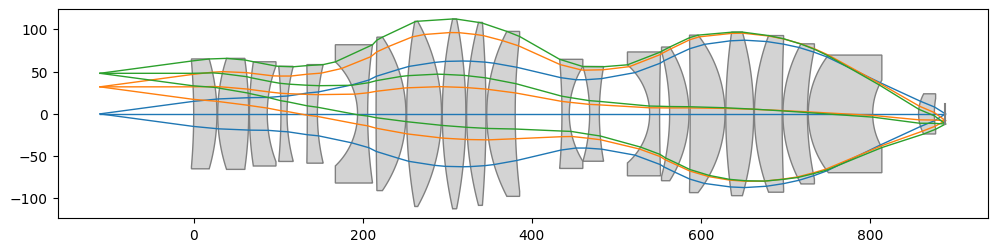
Assess initial MTF performance
- Initial Performance Assessment
Let's see how close the lens is to diffraction-limited by plotting the MTF:
lens_mtf = mtf.FFTMTF(lens)
lens_mtf.view(add_reference=True)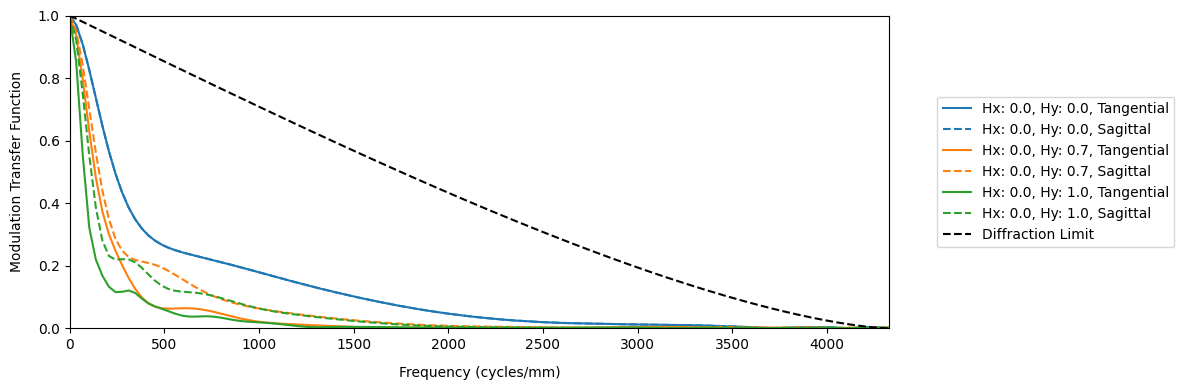
Set up the optimization problem
Clearly, the lens is far from the diffraction limit.
- Optimization
We now wish to make the lens diffraction-limited. Let's optimize the imaging performance by allowing all lens radii to vary.
problem = optimization.OptimizationProblem()

# Add focal length operand
problem.add_operand(
 operand_type="f2", target=494, weight=1, input_data={"optic": lens}
)

# Add OPD operands for imaging quality
for field in lens.fields.get_field_coords():
 input_data = {
     "optic": lens,
     "Hx": field[0],
     "Hy": field[1],
     "num_rays": 5,
     "wavelength": 0.248,
     "distribution": "gaussian_quad",
 }
 problem.add_operand(
     operand_type="OPD_difference",
     target=0,
     weight=10,
     input_data=input_data,
 )

# Allow the radii of curvature of all surfaces to vary
for k in range(1, lens.surface_group.num_surfaces - 1):
 problem.add_variable(
     lens,
     "radius",
     surface_number=k,
     min_val=-10000,
     max_val=10000,
 )

# Print current merit function value
problem.merit_info()Run the optimizer
We now run the standard optimizer. Note that this may take several minutes for a termination tolerance of 1e-9, but this should result in a high-performing lens.
optimizer = optimization.OptimizerGeneric(problem)
res = optimizer.optimize(tol=1e-9)Print post-optimization merit function
Printing the merit function result, we can see an improvement of ≈98%.
problem.merit_info()Plot the optimized MTF
Let's again view the MTF:
lens_mtf = mtf.FFTMTF(lens)
lens_mtf.view(add_reference=True)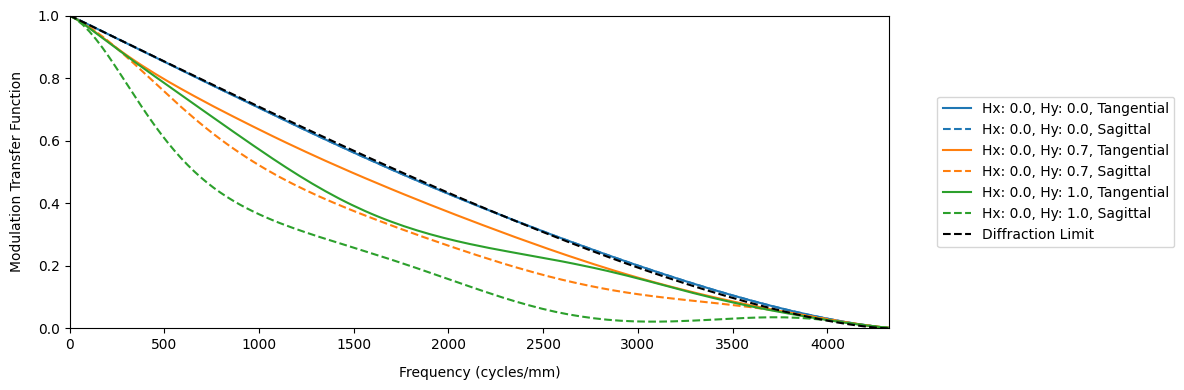
Compute the OPD wavefront map
This is a significant improvement over the initial design. We plot the diffraction limit as a reference.
Let's generate a few visualizations to show the final performance of the system. We will compute:
-
Wavefront OPD map for the (Hx, Hy) = (0, 1) field & corresponding standard Zernike coefficients
-
Standard spot diagram
-
Ray aberration fans
pythonopd = wavefront.OPD(lens, field=(0, 1), wavelength=0.248) opd.view(projection="2d", num_points=256)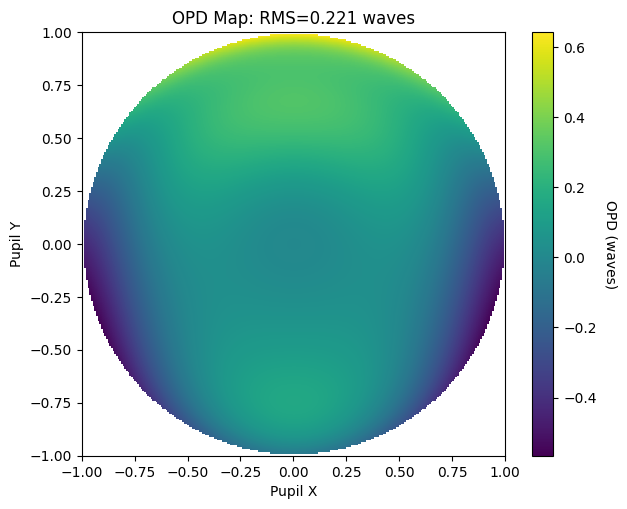
Extract Zernike wavefront coefficients
print("Zernike Standard Coefficients:")
zernike = wavefront.ZernikeOPD(
lens,
(0, 1),
0.55,
zernike_type="standard",
num_terms=21,
)
for k in range(len(zernike.coeffs)):
print(f"\tZ{k + 1}: {zernike.coeffs[k]:.8f}")View the spot diagram
spot = analysis.SpotDiagram(lens)
spot.view()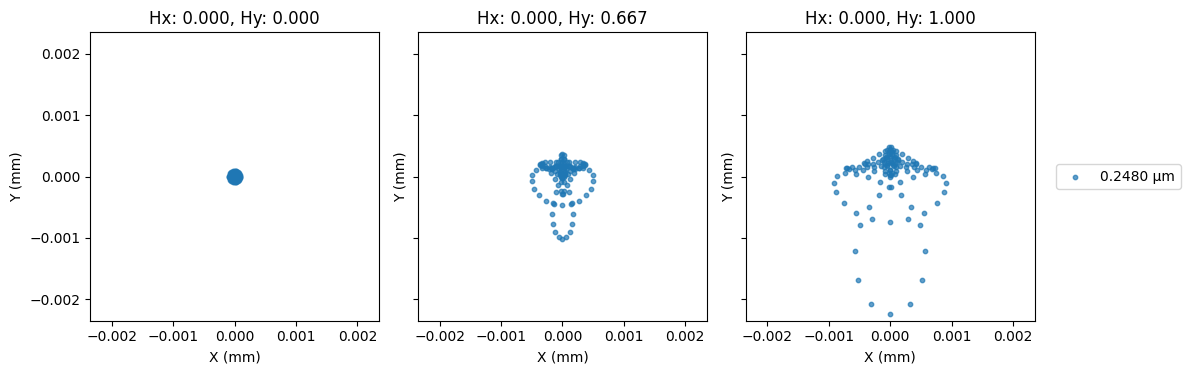
Plot the ray aberration fans
fan = analysis.RayFan(lens)
fan.view()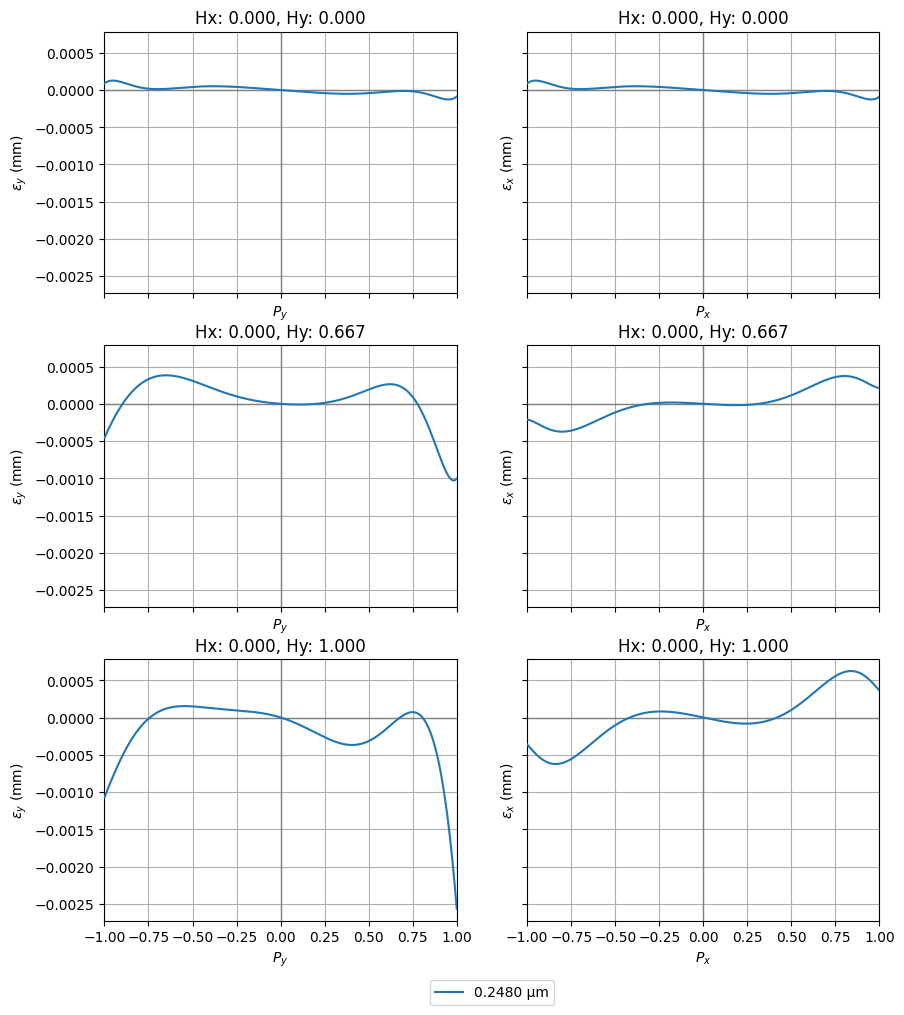
Print the final lens prescription
As a reference, we print the final optimized lens data:
lens.info()Show full code listing
import numpy as np
from optiland import analysis, materials, mtf, optic, optimization, wavefront
lens = optic.Optic()
# We define SiO2 with the index of refraction at 248 nm
SiO2 = materials.IdealMaterial(n=1.5084, k=0)
# Define all surfaces
lens.add_surface(index=0, radius=np.inf, thickness=110.85883544)
lens.add_surface(index=1, radius=-737.7847, thickness=27.484, material=SiO2)
lens.add_surface(index=2, radius=-235.2891, thickness=0.916)
lens.add_surface(index=3, radius=211.1786, thickness=36.646, material=SiO2)
lens.add_surface(index=4, radius=-461.3986, thickness=0.916)
lens.add_surface(index=5, radius=412.6778, thickness=21.071, material=SiO2)
lens.add_surface(index=6, radius=160.5391, thickness=16.197)
lens.add_surface(index=7, radius=-604.1283, thickness=7.215, material=SiO2)
lens.add_surface(index=8, radius=218.1877, thickness=23.941)
lens.add_surface(index=9, radius=-3586.063, thickness=11.978, material=SiO2)
lens.add_surface(index=10, radius=251.8168, thickness=47.506)
lens.add_surface(index=11, radius=-85.2817, thickness=11.961, material=SiO2)
lens.add_surface(index=12, radius=584.8597, thickness=9.968)
lens.add_surface(index=13, radius=4074.801, thickness=35.291, material=SiO2)
lens.add_surface(index=14, radius=-162.0185, thickness=0.923)
lens.add_surface(index=15, radius=629.544, thickness=41.227, material=SiO2)
lens.add_surface(index=16, radius=-226.7397, thickness=0.916)
lens.add_surface(index=17, radius=522.2739, thickness=27.842, material=SiO2)
lens.add_surface(index=18, radius=-582.424, thickness=0.916)
lens.add_surface(index=19, radius=423.729, thickness=22.904, material=SiO2)
lens.add_surface(index=20, radius=-1385.36, thickness=0.916, is_stop=True)
lens.add_surface(index=21, radius=212.039, thickness=33.646, material=SiO2)
lens.add_surface(index=22, radius=802.3695, thickness=55.304)
lens.add_surface(index=23, radius=-776.5697, thickness=8.703, material=SiO2)
lens.add_surface(index=24, radius=106.1728, thickness=24.09)
lens.add_surface(index=25, radius=-200.683, thickness=11.452, material=SiO2)
lens.add_surface(index=26, radius=311.8264, thickness=59.54)
lens.add_surface(index=27, radius=-77.2276, thickness=11.772, material=SiO2)
lens.add_surface(index=28, radius=2317.8032, thickness=11.862)
lens.add_surface(index=29, radius=-290.8859, thickness=22.904, material=SiO2)
lens.add_surface(index=30, radius=-148.3577, thickness=1.373)
lens.add_surface(index=31, radius=-5658.5043, thickness=41.227, material=SiO2)
lens.add_surface(index=32, radius=-151.9858, thickness=0.916)
lens.add_surface(index=33, radius=678.1005, thickness=32.981, material=SiO2)
lens.add_surface(index=34, radius=-358.554, thickness=0.916)
lens.add_surface(index=35, radius=264.2734, thickness=32.814, material=SiO2)
lens.add_surface(index=36, radius=2309.6884, thickness=0.916)
lens.add_surface(index=37, radius=171.2681, thickness=29.015, material=SiO2)
lens.add_surface(index=38, radius=364.7765, thickness=0.918)
lens.add_surface(index=39, radius=113.37, thickness=76.259, material=SiO2)
lens.add_surface(index=40, radius=78.6982, thickness=54.304)
lens.add_surface(index=41, radius=49.5443, thickness=18.65, material=SiO2)
lens.add_surface(index=42, radius=109.8136, thickness=13.07647896)
lens.add_surface(index=43, radius=np.inf)
# Define the aperture (the original NA was 0.15, but we reduce it slightly to avoid
# negative edge thicknesses)
lens.set_aperture(aperture_type="objectNA", value=0.133)
# Define the field
lens.set_field_type(field_type="object_height")
lens.add_field(y=0)
lens.add_field(y=32)
lens.add_field(y=48)
# Define the wavelength
lens.add_wavelength(value=0.248, is_primary=True)
# Specify that the lens is object-space telecentric
lens.obj_space_telecentric = True
# Move last surface to the paraxial image plane
lens.image_solve()
lens.draw(figsize=(12, 3))
lens_mtf = mtf.FFTMTF(lens)
lens_mtf.view(add_reference=True)
problem = optimization.OptimizationProblem()
# Add focal length operand
problem.add_operand(
operand_type="f2", target=494, weight=1, input_data={"optic": lens}
)
# Add OPD operands for imaging quality
for field in lens.fields.get_field_coords():
input_data = {
"optic": lens,
"Hx": field[0],
"Hy": field[1],
"num_rays": 5,
"wavelength": 0.248,
"distribution": "gaussian_quad",
}
problem.add_operand(
operand_type="OPD_difference",
target=0,
weight=10,
input_data=input_data,
)
# Allow the radii of curvature of all surfaces to vary
for k in range(1, lens.surface_group.num_surfaces - 1):
problem.add_variable(
lens,
"radius",
surface_number=k,
min_val=-10000,
max_val=10000,
)
# Print current merit function value
problem.merit_info()
optimizer = optimization.OptimizerGeneric(problem)
res = optimizer.optimize(tol=1e-9)
problem.merit_info()
lens_mtf = mtf.FFTMTF(lens)
lens_mtf.view(add_reference=True)
opd = wavefront.OPD(lens, field=(0, 1), wavelength=0.248)
 opd.view(projection="2d", num_points=256)
print("Zernike Standard Coefficients:")
zernike = wavefront.ZernikeOPD(
 lens,
 (0, 1),
 0.55,
 zernike_type="standard",
 num_terms=21,
)

for k in range(len(zernike.coeffs)):
 print(f"\tZ{k + 1}: {zernike.coeffs[k]:.8f}")
spot = analysis.SpotDiagram(lens)
spot.view()
fan = analysis.RayFan(lens)
fan.view()
lens.info()Conclusions
- Starting from a patent design, we optimized a lithographic projection lens to achieve near diffraction-limited performance
- While significantly improved, the final design still has room for improvement. For example, we could have introduced aspheres on some of the surfaces.
Next tutorials
Original notebook: Tutorial_7a_Lithographic_Projection_System.ipynb on GitHub · ReadTheDocs