Advanced Optimization
Use global search and multi-configuration solvers for complex designs.
Introduction
Building on tutorial 5a, this tutorial demonstrates further optimization functionalities including:
- Various operand types (paraxial, real ray-based, aberrations)
- Various variable types (radii, thickness, conic)
- Global optimization (e.g. dual annealing, differential evolution, SHGO, basin-hopping)
Core concepts used
Step-by-step build
Import numpy, analysis, optic, and optimization
import numpy as np

from optiland import analysis, optic, optimizationDefine the doublet lens with aperture, fields, and wavelengths
Let's define a non-optimized doublet, which we will optimize. Our goal in optimization will be to:
-
Control distortion via real ray intersection operands
-
Minimize spherical aberration
-
Minimize the spot size for each field
-
Maintain a focal length of 50 mm
pythonlens = optic.Optic() lens.surface_group.surfaces = [] lens.add_surface(index=0, radius=np.inf, thickness=np.inf) lens.add_surface(index=1, radius=50, thickness=5, material="N-BK7") lens.add_surface(index=2, radius=-500, thickness=10) lens.add_surface(index=3, radius=500, thickness=5, material="SK16", is_stop=True) lens.add_surface(index=4, radius=-50, thickness=35) lens.add_surface(index=5) # add aperture lens.set_aperture(aperture_type="EPD", value=8) # add field lens.set_field_type(field_type="angle") lens.add_field(y=0) lens.add_field(y=5.6) lens.add_field(y=8) # add wavelength lens.add_wavelength(value=0.4861327) lens.add_wavelength(value=0.5875618, is_primary=True) lens.add_wavelength(value=0.6562725) lens.update_paraxial()
Draw the initial lens layout
lens.draw()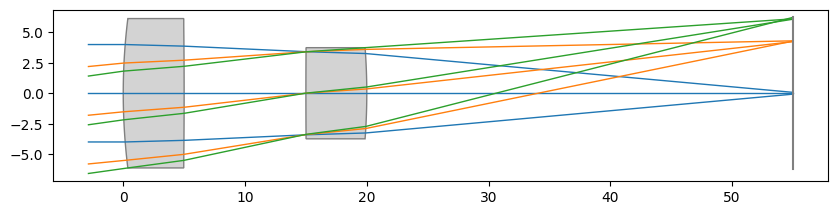
Add ray intercept, Seidel, RMS spot, and focal length operands
Let's define the optimization problem. First, let's add the operands:
problem = optimization.OptimizationProblem()
# add real ray operands - the intersection location is f*tan(theta), where f is the
# focal length and theta is the field half angle
input_data = {
"optic": lens,
"surface_number": 5,
"Hx": 0,
"Hy": 0.7,
"Px": 0,
"Py": 0,
"wavelength": 0.5875618,
}
problem.add_operand(
operand_type="real_y_intercept",
target=4.903,
weight=1,
input_data=input_data,
)
input_data = {
"optic": lens,
"surface_number": 5,
"Hx": 0,
"Hy": 1,
"Px": 0,
"Py": 0,
"wavelength": 0.5875618,
}
problem.add_operand(
operand_type="real_y_intercept",
target=7.027,
weight=1,
input_data=input_data,
)
# add operand to minimize spherical aberration - we will minimize the first
# seidel aberration (i.e. #1)
input_data = {"optic": lens, "seidel_number": 1}
problem.add_operand(operand_type="seidel", target=0, weight=1, input_data=input_data)
# add RMS spot size operand - let's minimize the spot size for each field at the
# primary wavelength we choose a 'uniform' distribution, so the number of rays actually
# means the rays on one axis. So, we acually trace ≈16^2 rays here.
for field in lens.fields.get_field_coords():
input_data = {
"optic": lens,
"surface_number": 5,
"Hx": field[0],
"Hy": field[1],
"num_rays": 16,
"wavelength": 0.5875618,
"distribution": "uniform",
}
problem.add_operand(
operand_type="rms_spot_size",
target=0,
weight=10,
input_data=input_data,
)
# add focal length target
problem.add_operand(operand_type="f2", target=50, weight=1, input_data={"optic": lens})Add thickness, radius, and conic variables and inspect the problem
Now, we can add the variables. Let's let one of the surfaces' conic constant vary. Lastly, we print the optimization problem information overview.
# thickness between the lenses and distance to image plane
problem.add_variable(lens, "thickness", surface_number=2, min_val=3, max_val=30)
problem.add_variable(lens, "thickness", surface_number=4, min_val=0, max_val=100)
# radii of all lenses
problem.add_variable(lens, "radius", surface_number=1, min_val=-1000, max_val=1000)
problem.add_variable(lens, "radius", surface_number=2, min_val=-1000, max_val=1000)
problem.add_variable(lens, "radius", surface_number=3, min_val=-1000, max_val=1000)
problem.add_variable(lens, "radius", surface_number=4, min_val=-1000, max_val=1000)
# conic constant of first lens surface
problem.add_variable(lens, "conic", surface_number=1, min_val=-10, max_val=10)
# print optimization problem info
problem.info()Run Differential Evolution global optimization
Let's optimize our system. There are many optimizers available, but we want to demonstrate a global optimization method: Differential Evolution. Optiland utilizes the scipy implementation of this optimization method.
This method can take some time. To speed up the calculation, we parallize the calculation and use all available CPU cores. We specify this by supplying -1 to the workers argument.
optimizer = optimization.DifferentialEvolution(problem)
# optimizer = optimization.SHGO(problem) # note SHGO requires bounds
# optimizer = optimization.BasinHopping(problem) # BasinHopping requires no bounds
res = optimizer.optimize(maxiter=256, disp=False, workers=-1)Draw the optimized lens layout
Let's see how the lens has changed after optimization:
lens.draw()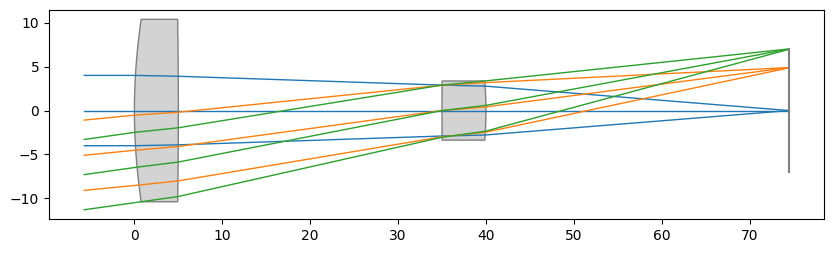
Review optimization improvement with problem.info()
By viewing the problem info, we can see that there was a greater than 99% improvement in performance, based on the defined operands.
problem.info()Plot the spot diagram after optimization
Let's perform a few analyses to check the final performance of our lens.
spot = analysis.SpotDiagram(lens)
spot.view()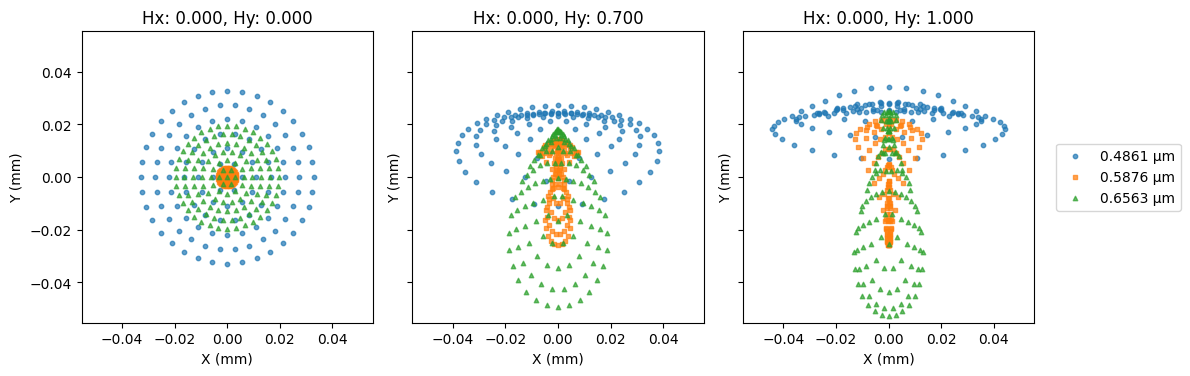
Plot the grid distortion
grid = analysis.GridDistortion(lens)
grid.view()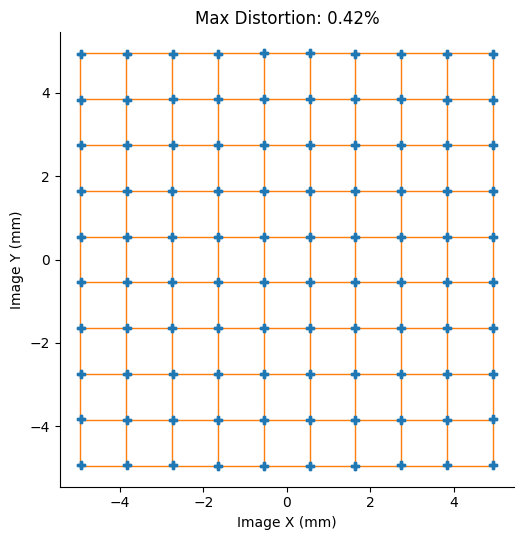
Print the Seidel aberration coefficients
print("Seidel Aberrations:")
for k, seidel in enumerate(lens.aberrations.seidels()):
print(f"\tS{k + 1}: {seidel:.3e}")Show full code listing
import numpy as np
from optiland import analysis, optic, optimization
lens = optic.Optic()

 lens.surface_group.surfaces = []

 lens.add_surface(index=0, radius=np.inf, thickness=np.inf)
 lens.add_surface(index=1, radius=50, thickness=5, material="N-BK7")
 lens.add_surface(index=2, radius=-500, thickness=10)
 lens.add_surface(index=3, radius=500, thickness=5, material="SK16", is_stop=True)
 lens.add_surface(index=4, radius=-50, thickness=35)
 lens.add_surface(index=5)

 # add aperture
 lens.set_aperture(aperture_type="EPD", value=8)

 # add field
 lens.set_field_type(field_type="angle")
 lens.add_field(y=0)
 lens.add_field(y=5.6)
 lens.add_field(y=8)

 # add wavelength
 lens.add_wavelength(value=0.4861327)
 lens.add_wavelength(value=0.5875618, is_primary=True)
 lens.add_wavelength(value=0.6562725)

 lens.update_paraxial()
lens.draw()
problem = optimization.OptimizationProblem()

# add real ray operands - the intersection location is f*tan(theta), where f is the
# focal length and theta is the field half angle
input_data = {
 "optic": lens,
 "surface_number": 5,
 "Hx": 0,
 "Hy": 0.7,
 "Px": 0,
 "Py": 0,
 "wavelength": 0.5875618,
}
problem.add_operand(
 operand_type="real_y_intercept",
 target=4.903,
 weight=1,
 input_data=input_data,
)

input_data = {
 "optic": lens,
 "surface_number": 5,
 "Hx": 0,
 "Hy": 1,
 "Px": 0,
 "Py": 0,
 "wavelength": 0.5875618,
}
problem.add_operand(
 operand_type="real_y_intercept",
 target=7.027,
 weight=1,
 input_data=input_data,
)

# add operand to minimize spherical aberration - we will minimize the first
# seidel aberration (i.e. #1)
input_data = {"optic": lens, "seidel_number": 1}
problem.add_operand(operand_type="seidel", target=0, weight=1, input_data=input_data)

# add RMS spot size operand - let's minimize the spot size for each field at the
# primary wavelength we choose a 'uniform' distribution, so the number of rays actually
# means the rays on one axis. So, we acually trace ≈16^2 rays here.
for field in lens.fields.get_field_coords():
 input_data = {
     "optic": lens,
     "surface_number": 5,
     "Hx": field[0],
     "Hy": field[1],
     "num_rays": 16,
     "wavelength": 0.5875618,
     "distribution": "uniform",
 }
 problem.add_operand(
     operand_type="rms_spot_size",
     target=0,
     weight=10,
     input_data=input_data,
 )

# add focal length target
problem.add_operand(operand_type="f2", target=50, weight=1, input_data={"optic": lens})
# thickness between the lenses and distance to image plane
problem.add_variable(lens, "thickness", surface_number=2, min_val=3, max_val=30)
problem.add_variable(lens, "thickness", surface_number=4, min_val=0, max_val=100)

# radii of all lenses
problem.add_variable(lens, "radius", surface_number=1, min_val=-1000, max_val=1000)
problem.add_variable(lens, "radius", surface_number=2, min_val=-1000, max_val=1000)
problem.add_variable(lens, "radius", surface_number=3, min_val=-1000, max_val=1000)
problem.add_variable(lens, "radius", surface_number=4, min_val=-1000, max_val=1000)

# conic constant of first lens surface
problem.add_variable(lens, "conic", surface_number=1, min_val=-10, max_val=10)

# print optimization problem info
problem.info()
optimizer = optimization.DifferentialEvolution(problem)
# optimizer = optimization.SHGO(problem)  # note SHGO requires bounds
# optimizer = optimization.BasinHopping(problem)  # BasinHopping requires no bounds

res = optimizer.optimize(maxiter=256, disp=False, workers=-1)
lens.draw()
problem.info()
spot = analysis.SpotDiagram(lens)
spot.view()
grid = analysis.GridDistortion(lens)
grid.view()
print("Seidel Aberrations:")
for k, seidel in enumerate(lens.aberrations.seidels()):
print(f"\tS{k + 1}: {seidel:.3e}")Conclusions
- We showed several different operands and variables that can be used in optimization.
- We demonstrated the use of differential evolution for optimization
- While the lens itself improved in performance, there is still room for improvement. Different operands, variables, or sequences of optimization steps would result in different, and possibly better, results.
Next tutorials
Original notebook: Tutorial_5b_Advanced_Optimization.ipynb on GitHub · ReadTheDocs