Tilting the object plane in a lens design

Hello everyone,
I am new to optiland as well as ray tracing in general, so there might be a lot wrong to the approach I am taking.
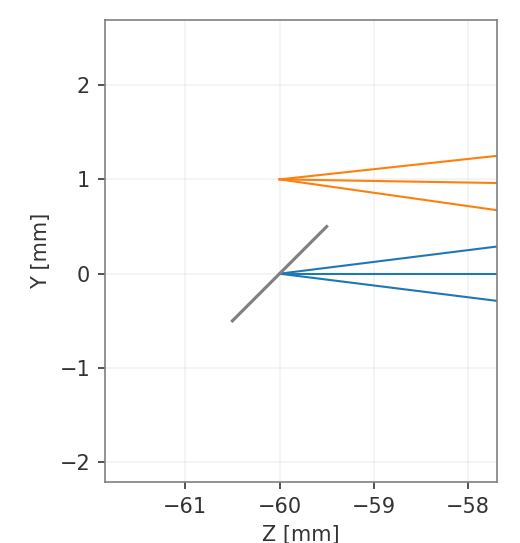
I would like to compute the imaging properties of a tilted object plane. Here is an example using the bi-complex lens of a tutorial:
lens = Optic()

lens.surfaces.add(index=0, thickness=60, rx = 45*np.pi/180)
lens.surfaces.add(index=1, thickness=7, radius=50, material="N-SF2", is_stop=True)
lens.surfaces.add(index=2, thickness=60, radius=-50)
lens.surfaces.add(index=3)

lens.set_aperture(aperture_type="EPD", value=15)
lens.fields.set_type(field_type="object_height")
lens.fields.add(y=0)
lens.fields.add(y=1)

lens.wavelengths.add(value=0.55, is_primary=True)
At construction, the system allows me to tilt the object surface to 45°. But when I run lens.draw() or try to run analyses, clearly the off-axis field is traced from the same z-value as the on-axis one.
What would be the best way to do this? I tried tilting the whole system (11 surfaces in my case) and using ray aiming to fill the NA. It works but tracing gets very slow (too slow for optimization I think). Maybe it's only a matter of finding the right parameters for sct.ray_tracer.set_aiming and the correct distribution (I am using hexapolar).
In any case, many thanks for all the efforts put into optiland! I will try to be a force for good and help people in this forum :)
Nico