Coloring Lens Elements by Glass Property#
By default every lens element in a layout is drawn the same color, so the glass choices behind a design are invisible. A PropertyColorizer maps a scalar property of each element to a color. Optiland provides two value functions for glass properties:
abbe_number: the Abbe number \(V_d\), computed from the indices at the d, F and C lines.refractive_index(wavelength): the index at a given wavelength (the primary wavelength if omitted).
Elements without a value, such as mirrors or materials without dispersion data, keep the default color.
[1]:
from optiland.samples.objectives import CookeTriplet
from optiland.samples.simple import CementedAchromat
from optiland.visualization.coloring import (
    ColorScale,
    ComponentRef,
    PropertyColorizer,
    abbe_number,
    refractive_index,
)
Abbe number of a cemented achromat#
An achromat pairs a low-dispersion crown (high \(V_d\)) with a high-dispersion flint (low \(V_d\)). Coloring by Abbe number makes the pairing visible at a glance.
[2]:
achromat = CementedAchromat()
fig, ax = achromat.draw(
    component_colorizer=PropertyColorizer(
        abbe_number, ColorScale(cmap="coolwarm_r", label="Abbe number")
    )
)
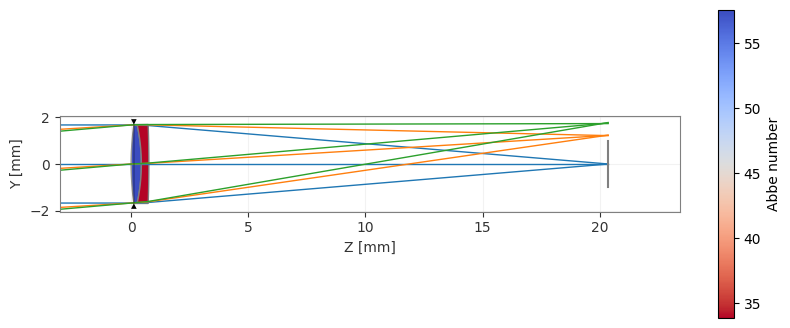
The value functions can also be called directly, which is a quick way to check the numbers behind the colors.
[3]:
n_d = refractive_index(0.5876)
for ref in (ComponentRef("lens_element", (1, 2)), ComponentRef("lens_element", (2, 3))):
    glass = achromat.surfaces[ref.surface_indices[0]].material_post
    print(
        f"{glass.display_name:7s} n_d = {n_d(achromat, ref):.5f}   "
        f"V_d = {abbe_number(achromat, ref):.2f}"
    )
N-BAK1  n_d = 1.57250   V_d = 57.55
SF2     n_d = 1.64769   V_d = 33.85
Abbe number of a Cooke triplet#
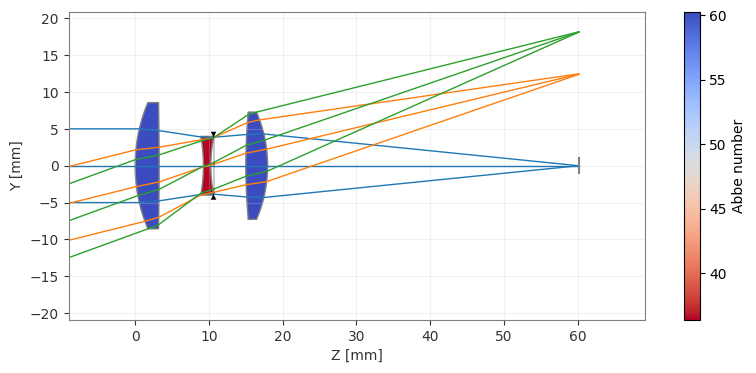
The Cooke triplet places a flint negative element between two crown positive elements. Its glasses have almost the same index, so the crown-flint-crown structure only shows up in the dispersion.
[4]:
triplet = CookeTriplet()
fig, ax = triplet.draw(
    component_colorizer=PropertyColorizer(
        abbe_number, ColorScale(cmap="coolwarm_r", label="Abbe number")
    )
)
Refractive index#
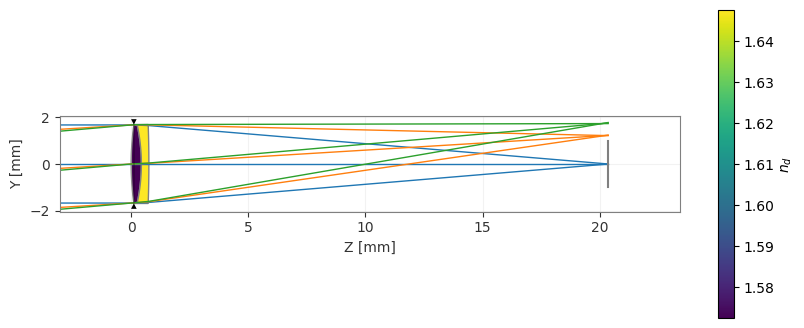
refractive_index takes a wavelength in microns. Without one it uses the optic’s primary wavelength, which is the d line for this achromat.
[5]:
fig, ax = achromat.draw(
    component_colorizer=PropertyColorizer(
        refractive_index(), ColorScale(label="$n_d$")
    )
)