Paraxial Surfaces#
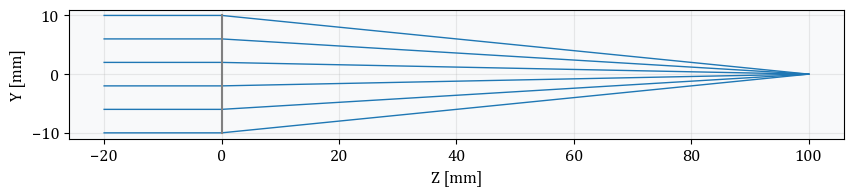
This example shows how paraxial surfaces can be defined in Optiland. These are defined solely based on their focal length and can be used for first order system layouts.
[1]:
import numpy as np

from optiland import optic
[2]:
lens = optic.Optic()

# add surfaces
lens.surfaces.add(index=0, thickness=np.inf)
lens.surfaces.add(index=1, surface_type="paraxial", thickness=100, f=100, is_stop=True)
lens.surfaces.add(index=2)

# add aperture
lens.set_aperture(aperture_type="EPD", value=20)

# add field
lens.fields.set_type(field_type="angle")
lens.fields.add(y=0)
# lens.fields.add(y=5)

# add wavelength
lens.wavelengths.add(value=0.55, is_primary=True)

lens.draw(num_rays=6)